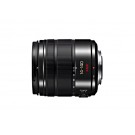
The G Vario 45-200mm f/4.0-5.6 MEGA O.I.S. lens that will be offered with the G1 camera body as part of a twin-lens kit has been designed to complement the 14-45mm kit lens. Like the G1 kit lens, it's not Leica branded but, covering a focal length range equivalent to 90-400mm in 35mm format, it provides a useful zoom range for applications as diverse as portraiture and shooting sports and wildlife.
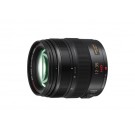
Build quality and overall design are similar to its 14-45mm 'cousin', with the lens barrel made from two-tone polycarbonate (plastic). The section of the lens barrel closest to the camera body is gunmetal grey, while the rest of the lens is matte black. The stainless steel lens mount carries 11 electrical contacts that enable the microprocessor in the camera body to interact with the lens and support the camera's contrast-based AF system.
Optical construction comprises16 elements in 13 groups with three ED (extra-low dispersion) elements to provide clarity and accurate colour reproduction. All elements are multi-coated to minimise flare and ghosting. Seven diaphragm blades close to produce a circular iris, resulting in an attractive smoothness in out-of-focus areas when shooting with wide apertures.
Internal focusing allows use of angle-critical filters like polarisers and graduates but you can't adjust their position with the lens hood in place. MEGA O.I.S. image stabilisation technology is built into the optical system to counteract the effects of camera shake. The front of the lens is threaded for a 52 mm filter, just like the 14-15mm G1 kit lens. The lens cap clips into the filter thread.
The zoom ring is closer to the camera body. It's approximately 30 mm wide and has a ridged rubber coating over most of its width to provide a secure grip. The leading edge carries engraved marking for the 45mm, 60mm, 75mm, 100mm, 150mm and 200mm settings. These line up against an engraved mark on a non-moving section of the lens barrel that also carries the MEGA O.I.S. on/off slider switch.
In front of this section is the focusing ring which is approximately 12 mm wide and is made from hard, ridged plastic. This ring moves within its own 'channel' in the outer barrel. Supplied accessories include a cylindrical lens hood, which has a ridged inner surface to subdue reflections plus front and rear caps and a soft storage bag.
Handling
The G Vario 45-200mm lens complements the Panasonic DMC G1 body extremely well and its small size and light weight provide a comfortable balance. The metal bayonet mount is easy to attach to the camera body and fits snugly. We had no problems fitting the cylindrical lens hood, which also attaches via a bayonet mounting.
Moving through the zoom range requires just under a quarter of a turn, which extends the lens by approximately 40mm. We found the markings on the lens barrel corresponded well with the actual focal length settings at 60mm and 75mm but had drifted slightly off the mark and produced focal length settings that were 1mm and 3mm higher than indicated at 100mm and 150mm respectively.
The focusing ring moves through 360 degrees and it was initially difficult to estimate how much it had to be turned to go from the closest focus to infinity. Fortunately, the G1 provides some useful manual focusing assistance via the MF Assist function, which enlarges the centre of the image on both the LCD monitor and the EVF. No zoom lock is provided but we found no tendency for the lens to 'creep' when it was carried pointing downwards.
Performance
In bright conditions, autofocusing was generally fast and accurate and the camera locked onto subjects almost instantaneously. In lower light levels, AF performance was slightly better than the 14-45mm kit lens. Hunting occurred less frequently and the test camera usually took well under a second to lock onto subjects.
200mm focal length, ISO 100, 1/20 second at f/13
In our Imatest assessments we found the test lens performed best at the widest apertures with the 45mm focal length but at apertures between f/5.0 and f/10 for all other focal lengths. Diffraction began to influence image resolution between f/11 and f/16 and performance deteriorated steadily thereafter. The graph below shows the results of our tests and confirms the general edge-to-edge sharpness of the lens.
Lateral chromatic aberration remained consistently in the 'negligible' range, as shown in the graph below. (Note: the red line marks the border between 'negligible' and 'low' C.A.) We found no evidence of coloured fringing in test shots taken in contrasty situations.
Distortion was also minimal. No distortion was obvious at the 45mm setting but a trace of pincushion distortion could be seen at 60mm. This persisted without becoming significantly more noticeable up to 100mm and then increased marginally at 150mm and 200mm. (This distortion would only be troubling to photographers who required total dimensional accuracy in images.)


















 Designated trademarks and brands are the property of their respective owners.












